Hair seen on a pillow or in the shower does not tell you whether you have temporary shedding, follicle miniaturisation, patchy autoimmune loss, traction damage or breakage. By separating those patterns and comparing treatment claims with measurable outcomes, you can decide which assessment, therapy or referral is worth your time—and when a cosmetic package is the wrong first step.
Key takeaways
- Match treatment to the pattern: thinning, shedding, or a bare patch.
- Ask for a diagnosis before choosing Hairfall Control, PRP, or GFC.
- Check medicine interactions, supplement doses, risks, and review timelines.
- Compare consultation quality, documentation, pricing, and follow-up before booking in Juhu.
Identify the pattern before you choose a hairfall benefit
Match timing, distribution, and scalp signs before choosing a benefit: gradual thinning is not the same problem as sudden shedding or a bare patch. The phrase hairfall treatment for adults juhu is not a diagnosis.
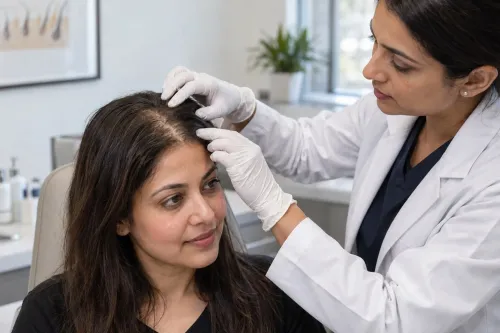
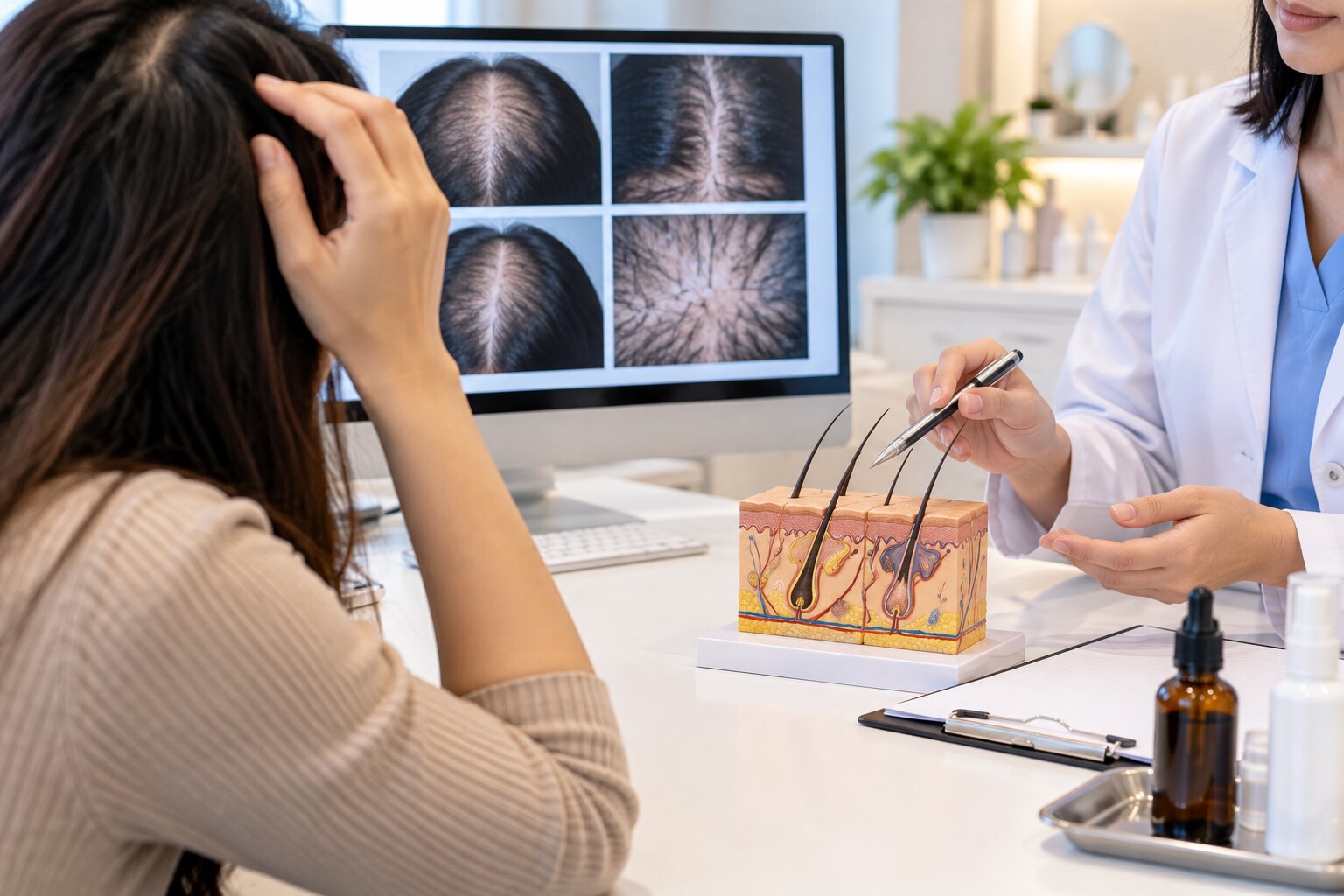
A proper assessment uses onset and triggers, scalp examination, dermoscopy, a hair-pull test, and selected blood tests; shower-hair counts alone cannot show whether density is falling.
- Diffuse shedding that starts two to four months after fever, surgery, childbirth, major stress, or weight loss fits telogen effluvium. The useful target is correcting the trigger, not an instant procedure result.
- A widening part, receding temples, or crown thinning over years fits androgenetic alopecia. Treatment aims to preserve miniaturised follicles; dramatic regrowth is less predictable.
- Smooth, sharply outlined patches, eyebrow or beard loss, and nail changes suggest alopecia areata. It needs diagnosis and immune-directed care; minoxidil alone does not treat its cause.
- Broken short hairs, split ends, or a rough hairline indicate shaft breakage rather than follicle loss.
- Hairline thinning beneath tight braids or ponytails fits traction alopecia. Continued tension can permanently destroy follicles.
- Itch, pain, redness, heavy scale, or shiny skin raises inflammatory or scarring alopecia. Seek dermatology review promptly.
| What you notice | Pattern it suggests | First useful step |
|---|---|---|
| Diffuse shedding | Telogen effluvium | Review triggers and medicines |
| Gradual density loss | Androgenetic alopecia | Assess miniaturisation with dermoscopy |
| Smooth patch or shiny scalp | Alopecia areata or scarring loss | Arrange prompt medical diagnosis |
Match the promised benefit to the diagnosis
The useful hairfall control benefits by hair loss type in Juhu depend on the endpoint: less shedding, preserved density, patch regrowth, symptom relief or cosmetic coverage. A treatment that suits gradual pattern thinning will not correct a scarred follicle or reverse breakage along the hair shaft.
| Type of loss | Treatment should achieve | Realistic time frame |
|---|---|---|
| Telogen effluvium after illness, stress, weight loss or childbirth | Find and correct the trigger, then support gradual recovery; do not promise instant shedding control | Shedding often settles over months after the trigger is addressed |
| Androgenetic alopecia | Slow follicle miniaturisation and preserve existing density; regrowth is less predictable in long-standing thinning | Assess after several months; maintenance treatment is usually needed |
| Alopecia areata | Confirm the diagnosis and encourage regrowth in smooth patches under medical supervision | Patch response varies; sudden or extensive loss needs prompt review |
| Traction alopecia | Stop pulling, friction and damaging extensions or chemicals before follicles are permanently lost | Early improvement takes months; established scarring may not reverse |
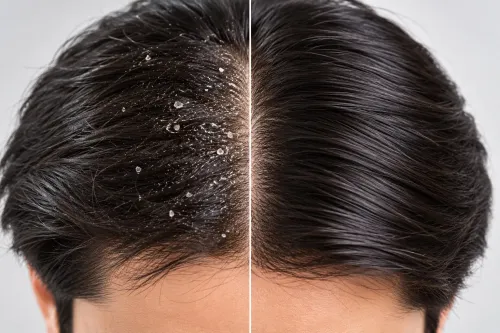
| Scalp inflammation or seborrhoeic dermatitis | Control itching, scaling and inflammation; do not treat dandruff as pattern loss | Symptoms can improve sooner than density |
| Breakage | Reduce heat, chemicals and friction to prevent further shaft damage; growth procedures will not repair broken lengths | New, stronger growth appears as the hair grows |
| Scarring alopecia | Stop active inflammation and protect remaining follicles; follicle stimulation cannot regrow scarred areas | Needs prompt specialist assessment |
Ask how the recommendation was reached. A useful assessment combines onset and trigger history, scalp examination, dermoscopy and, when diffuse shedding suggests a systemic cause, selected blood tests. A hair-pull test alone cannot distinguish these conditions. Sudden patches, pain, scaling, eyebrow loss or a shiny scalp warrant medical review before any package.
Compare Hairfall Control, scalp rejuvenation, PRP and GFC by effort and evidence
“Hairfall control benefits in Juhu” should mean a defined outcome, not a package name. Less shedding, preserved density, patch regrowth and thicker strands require different diagnoses. A generic scalp procedure is the wrong first step for telogen effluvium, alopecia areata, active dermatitis or scarring alopecia.
| Option | Purpose and evidence | Sessions, recovery and realistic result |
|---|---|---|
| Hairfall control | Assessment, trigger correction and treatments such as minoxidil for pattern loss. Evidence depends on the diagnosis, not the label. | Often ongoing management rather than a fixed course. No procedure recovery. Expect slower shedding or preserved density; pattern regrowth takes months. |
| Scalp rejuvenation | Umbrella term for microneedling, laser, serums or infusions. Protocols and evidence vary, so ask what device or substance is used. | Usually repeated visits. Redness, tenderness or flaking can follow needling. Results are modest and cannot revive scarred follicles. |
| PRP | Concentrated platelet preparation injected into the scalp; some adults with androgenetic alopecia gain thickness or density, but studies use different protocols. | Usually a planned series, with injection soreness or swelling for a short period. Benefits are gradual and maintenance may be needed; dramatic regrowth is not reliable. |
| GFC | Growth-factor concentrate prepared from blood without relying on intact platelets. Evidence remains less consistent than promotional claims. | Commonly sold as multiple sessions, but schedules differ. Expect temporary injection-site discomfort, not guaranteed regrowth. |
Ask for baseline photographs, the diagnosis, the number and spacing of sessions, and the endpoint being measured. If sudden shedding followed fever, childbirth or weight loss, correcting the trigger matters more than adding injections. That distinction protects you from paying for effort without evidence.
Account for medicines, supplements, safety and the time needed to judge results
Measure treatment by a defined endpoint: less shedding, preserved density, regrowth in patches or relief from scalp symptoms. For pattern loss, topical minoxidil needs consistent use and often several months before assessment; an early temporary increase in shedding can occur. Stopping it usually removes the maintenance benefit.
- Review medicines and health triggers before booking procedures. Diffuse shedding after fever, childbirth, major stress, weight loss or a new medicine needs a history and examination; a clinician may order a complete blood count, ferritin and thyroid-stimulating hormone test when iron deficiency or thyroid disease is suspected.
- Use prescription treatments only after diagnosis. Spironolactone may suit selected women with pattern thinning, but pregnancy precautions and medical supervision are essential. Finasteride is not appropriate for everyone, and pregnancy exposure requires strict avoidance.
- Treat supplements as corrections, not boosters. Take iron, vitamin D, zinc or other supplements only when a clinician identifies deficiency or a clear indication. High-dose biotin can distort thyroid and cardiac blood-test results, so report it before testing.
- Stop and seek assessment for sudden smooth patches, eyebrow loss, pain, intense itching, scaling, pus or shiny scalp skin. These signs can indicate alopecia areata, infection or scarring, where routine hairfall packages can delay useful treatment.
Take baseline photographs of the parting, hairline and patches in the same light, and record shedding and side effects monthly. Judge hair loss treatment benefits juhu claims against the agreed timeline: three to six months for many pattern-loss assessments, sooner for worsening symptoms.
Use a Juhu clinic checklist before booking a package
Ask a clinic to name the suspected cause before it recommends a package. A useful consultation connects one endpoint—less shedding, preserved density, patch regrowth or symptom control—to a timeframe. “Hairfall clinic juhu” searches should not end with a generic plan based only on the hair in your shower.
1. What is your working diagnosis: pattern hair loss, telogen effluvium, alopecia areata, traction alopecia, inflammation or breakage?
2. Which findings support it? Ask whether the clinician reviewed your onset, illness, childbirth, weight change, medicines and hairstyles, then performed a scalp examination, hair-pull test and dermoscopy.
3. Which tests are justified? For diffuse shedding, ask whether blood tests such as a complete blood count, ferritin and thyroid testing are needed. Ask where suspected alopecia areata or scarring alopecia will be referred.
4. What result will you measure, and when? Request baseline photographs of the parting and hairline, a review date, and a definition of improvement rather than “reduced hair fall.”
5. What happens if the diagnosis changes? Get the session count, total cost, maintenance plan, side effects, and cancellation terms in writing before paying.
Inshine Aesthetics should be assessed by the same checklist: its hair analysis must explain why the proposed treatment fits your findings, not simply attach “hairfall control benefits juhu” to every form of hair loss. Avoid a package that promises rapid regrowth for sudden shedding, smooth patches, pain, scaling or eyebrow loss.
Related services
Hair Treatment Combat Hair Fall with Our Effective Treatments Regain your confidence with our advanced hair fall control solutions. View service → |
Hair Treatment Effective Hair Regrowth Treatment Regain your confidence with our advanced hair regrowth solutions. View service → |
Frequently asked questions
How do I identify my type of hair loss before choosing treatment?
Compare timing, distribution, and scalp signs. Gradual crown or part-line thinning differs from sudden shedding or a sharply defined bare patch.
How should I match a promised hairfall benefit to my diagnosis?
Choose benefits that address the identified cause, such as pattern thinning, inflammation, nutritional deficiency, or an active scalp disorder. Request a diagnosis before paying for a package.
How do Hairfall Control, scalp rejuvenation, PRP, and GFC compare?
Compare the procedures by appointments, injections, downtime, preparation, evidence for your diagnosis, and the time required to judge results.
What should I check before booking a hairfall clinic in Juhu?
Ask who will diagnose you, what examination and tests are included, which products or medicines are used, how adverse effects are handled, and what follow-up schedule and total cost apply.
Related services
Hair Treatment Revitalise your scalp & boost hair growth. What is Scalp Rejuvenation? - Non-invasive treatment to nourish scalp - Exfoliates & stimulates blood flow... View service → |
Hair Treatment GFC Treatment for Hair Regrowth Stimulate hair growth with Growth Factor Concentrate (GFC) therapy. View service → |
Hair Treatment Treatment Say goodbye to dandruff & flaky scalp. Our Treatment: - Deep cleansing & medicated therapies - Scalp exfoliation & soothing treatments -... View service → |
Hair Treatment PRP Treatment for Hair Regrowth Boost hair growth with Platelet-Rich Plasma (PRP) therapy. View service → |
Keywords